Whale and dolphin watching in Tenerife
Updated 18 November 2026. Rules and harbours checked the same day.
Short-finned pilot whales and bottlenose dolphins live off the south-west coast of Tenerife all year round, a few kilometres from the harbours of the south. A boat trip of a few hours is usually enough to see them, in any season. This page lays out a whale-watching morning, then what you can see, where the boats leave from and the rules that a licensed boat follows.
Quick answer
- What you will see: pilot whales and bottlenose dolphins, which live off the island all year. Other species pass through, especially in May and June.
- Where from: Los Gigantes, Puerto Colón in Costa Adeje and Los Cristianos. Book a trip from Los Gigantes.
- Pick a licensed boat: it flies the blue “Barco Azul / Blue Boat” flag given by the Canary Islands government.
- On board: no swimming with the animals, no feeding, and the boat stays at least 60 metres away.
On this page
- A whale-watching morning from Los Gigantes
- What you can see up to 21 species
- Harbours Los Gigantes, Puerto Colón, Los Cristianos
- Responsible watching 60 m, 30 minutes
- Choosing a trip
- Where to stay
- FAQ
We may earn a commission when you book through our links. How it works
A whale-watching morning, hour by hour
The pilot whales and dolphins feed in the deep water a few kilometres off the coast between Teno and Rasca, so the whole south-west works as a base. This morning starts at Los Gigantes, where the cliffs make the trip worth it even on a quiet day.
- Los Gigantes harbourBe at the marina 15 minutes before your boat. Bring a jacket: it is cooler at sea than on the quay.
- Along the cliffsThe boat heads out under the Los Gigantes cliffs, which rise about 600 metres straight from the sea.
- Out to the pilot whalesA few kilometres offshore the guide looks for blows and fins. Near the animals the boat slows right down.
- Back towards the coastLonger trips often stop in a bay for a swim, well away from the animals: swimming near them is not allowed.
- Lunch in Puerto de SantiagoBack on dry land, the seafront next to Los Gigantes has restaurants with a view of the cliffs.
Times are an example: each operator sets its own departures and length of trip. Mornings are often calmer at sea.
Whale-watching trips
Tenerife : Los Gigantes Whale Watching Charter by Sail Boat
The most scenic start: the cliffs on the way out, then the pilot whales offshore.
3 hours
Free cancellation
CliffsSmall boatfrom €75
Booked on Viator
Whale and Dolphin Watching Catamaran with Transfer and Buffet
More room on deck and steadier in a swell, close to the hotels of Costa Adeje.
3 hours
Free cancellation
CatamaranFamiliesfrom €63
Booked on Viator
Ecological whale watching in Tenerife in a small group
Fewer people on board, so everyone gets the rail when the dolphins come alongside.
2 hours
Free cancellation
Small groupClose upfrom €65
Booked on Viator
What you can see off Tenerife
Up to 21 species of whales and dolphins have been recorded in these waters. Two of them live here all year, in the same area, which is why trips run in every season:
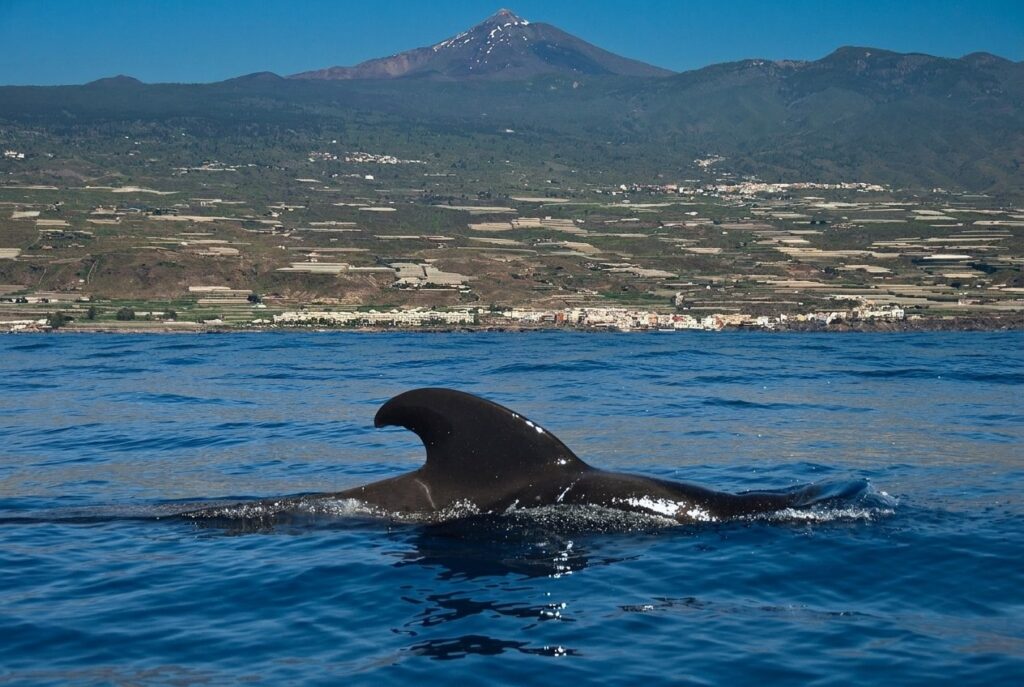
- Short-finned pilot whale. The one you are most likely to see. Dark, with a rounded head, it grows to more than 5 metres and weighs up to two tonnes.
- Bottlenose dolphin. Grey, about 2.5 to 3 metres long, in groups of 10 to 30. It often comes to ride the bow of the boat.
Other species turn up at different times of year: Atlantic spotted dolphins from autumn to late spring, common dolphins in winter, sperm whales most often in spring, and Bryde’s whales, Risso’s dolphins and rough-toothed dolphins now and then. Blue whales, humpbacks and orcas are rare. May and June are the best months for variety.
| Species | When | How often |
|---|---|---|
| Short-finned pilot whale | All year | Resident, seen on most trips |
| Bottlenose dolphin | All year | Resident, seen often |
| Atlantic spotted dolphin | Autumn to late spring | Visitor |
| Common dolphin | Winter | Seasonal |
| Sperm whale | Mostly spring | Visitor |
The island’s tourist board puts the odds of a sighting close to 100%, with trips going out on about 8 days out of 10. The days lost are those with too much wind and swell.
Where the boats leave from
Whale-watching boats leave from the harbours of the south and west, all within reach of the resorts:
- Los Gigantes, in the west: the shortest run to the cliffs, a good choice if you want the scenery as well as the animals. Some trips go on to the bay below Masca.
- Puerto Colón, the marina of Costa Adeje: the most departures, many of them on larger catamarans, close to the hotels of Costa Adeje and Playa de las Américas.
- Los Cristianos: the ferry port, with trips that head west along the coast.
- Las Galletas, a fishing village in the far south, with a small marina and quieter boats.
Most operators pick you up from your hotel or ask you to meet at the marina. Without a car, a trip from the harbour nearest your hotel saves a long transfer.
Responsible whale watching
Whale watching in the Canary Islands is regulated by a decree of the regional government. Every boat that takes paying passengers to see cetaceans needs a licence, must carry a tourist guide on board and must fly the “Barco Azul / Blue Boat” flag, which the Canary Islands government hands out with the licence and renews every year. No flag, no licence: that is the first thing to look for at the marina.
The rules a licensed boat follows
- It never approaches closer than 60 metres to a whale or a group of dolphins, and does not start the engine or reverse within that distance.
- Within 500 metres of the animals it slows to 4 knots, or to the speed of the slowest animal.
- It stays no more than 30 minutes within 100 metres of a group.
- No more than two boats within 100 metres of the same group, and no more than three within 500 metres.
- It never cuts across the animals’ path, circles them or chases them, and never approaches head-on or from straight behind.
- No loud noise, no food or waste thrown overboard within 500 metres.
What you should not do
- Swimming or diving within 500 metres of whales or dolphins is not allowed, even if the boat stops.
- Do not touch or feed the animals.
- Jet skis must stay more than 500 metres away from them: a jet-ski safari is not a way to see whales.
- If you find a stranded or injured whale or dolphin, call 112, the emergency number.
A protected stretch of sea
The sea off the west and south-west coast, from Teno to Rasca, is a protected marine area of almost 70,000 hectares, a Special Area of Conservation of the European Natura 2000 network. In January 2021 the waters between Tenerife and La Gomera became the first Whale Heritage Site in Europe, a label of the World Cetacean Alliance for places where whales are watched responsibly.
Choosing your trip
All licensed boats follow the same rules near the animals, so the choice comes down to the boat and the length of the trip:
- Catamarans are steadier in a swell and have shade, toilets and room to move: the easy choice with children or if you get seasick.
- Small boats carry fewer people and sit closer to the water, for photographers and for a quieter trip.
- Longer trips often add the Los Gigantes cliffs, a stop to swim in a bay and lunch on board.
- Mornings tend to have calmer seas than afternoons, when the wind picks up.
Ask whether the trip includes a stop for swimming and whether there is a marine guide on board when you book.
Small
Ecological whale watching in Tenerife in a small group
2 hours, from €65, free cancellation
Where to stay for boat trips
Staying near a marina means a short walk to the boat and an early start when the sea is calm.
Whale watching questions
When is the best time to see whales in Tenerife?
Any time of year: pilot whales and bottlenose dolphins live off the island all year. May and June bring the most other species. Mornings are usually calmer at sea.
Will I definitely see whales?
Not definitely, but nearly always: the resident pilot whales and dolphins stay in the same area. Trips are cancelled on days with too much wind and swell, about 2 days in 10.
How do I know a boat is licensed?
It flies the blue “Barco Azul / Blue Boat” flag of the Canary Islands government, given with the licence and renewed every year, and carries a tourist guide on board.
Can I swim with the dolphins?
No. Swimming or diving within 500 metres of whales or dolphins is not allowed. Many trips stop for a swim in a bay, away from the animals.
Which harbour is best?
Los Gigantes for the cliffs, Puerto Colón in Costa Adeje for the widest choice of boats, Los Cristianos if you are staying there. The animals are a few kilometres off all of them.
Read next
- Boat trips under the Los Gigantes cliffsMore boat trips under the cliffs of the west coast
- Things to do in TenerifeEverything else worth doing on the island
- Where to stay in TenerifeNorth or south: the best base for your days