Scuba diving in Tenerife: sites and try dives
Updated 18 November 2026. Dive sites and rules checked the same day.
Tenerife is a diving island all year round: the water stays between 19 and 26 °C, visibility ranges from 10 to 30 metres, and the volcanic coast drops fast into arches, caves and lava reefs. This page lays out a first day of diving, then the best sites by level, how a try dive works and the rules for certified divers.
Quick answer
- First dive: a try dive with an accredited centre, no licence or experience needed. PADI’s try dive is open from the age of 10.
- Easiest sites: Montaña Amarilla and Los Chuchos in the south, and Abades on the east coast: shallow, with little current.
- Water: 19 to 26 °C all year, with 10 to 30 metres of visibility.
- After diving, leave Teide for another day: the cable car climbs to 3,555 metres.
On this page
- A first diving day try dive in the south
- Dive sites more than 60 sites
- Marine life
- Try dives and courses no licence needed
- Rules licence, insurance
- Where to stay
- FAQ
We may earn a commission when you book through our links. How it works
A first diving day, hour by hour
Many dive centres are based in the south, around Los Cristianos, Las Galletas and Puerto Colón, where the sea is usually calmer than on the north coast. A try dive takes the morning and leaves the afternoon free.
- The dive centreFill in the medical form, then the instructor kits you out with a wetsuit, mask, fins and tank.
- BriefingHow to breathe from the regulator, clear your mask and equalise your ears, plus the hand signals.
- Shallow waterThe same skills again where you can stand, before going any deeper.
- The diveDown to a few metres with the instructor next to you, over sand, rock and shoals of fish.
- Back on landRinse the kit, sign your logbook and ask about a second dive or the Open Water course.
- Lunch and the beachAn easy afternoon in Los Cristianos: keep Teide for another day.
Times are an example: each centre sets its own start times. Mornings are often calmer at sea than afternoons.
Dives and courses
Tenerife: First-Time Scuba Diving in a Natural Turtle Habitat
A first breath underwater with an instructor, no experience needed.
2 hours 30 minutes
Free cancellation
1st diveBeginnersfrom €75
Booked on Viator
PADI Open Water Diver Course (OWD) – 2.5 days
The first licence, which lets you dive to 18 metres with a buddy anywhere in the world.
Theory and dives over two to three days
Free cancellation
LicenceCoursefrom €599
Booked on Viator
Scuba Diving for Certified Divers in Costa Adeje
A site 10 to 25 minutes by speed boat from Puerto Colón, chosen on the day for the sea and the visibility.
2 hours 30 minutes
Free cancellation
BoatCertifiedfrom €55
Booked on Viator
The best dive sites by level
The island has more than 60 dive sites, from shallow bays to walls below 40 metres. The south and the east have the calmest water; the north coast is wilder, with deeper sites for experienced divers.
Easy sites
| Site | Where | Max depth | Access |
|---|---|---|---|
| Montaña Amarilla | Ten Bel, Arona | 25 m | From the shore or by boat |
| Los Chuchos | Las Galletas, Arona | 25 m | By boat |
| El Condesito wreck | El Palm-Mar, Arona | 20 m | By boat |
| Abades | Arico | 25 m | From the shore |
| Cueva Cerebros | Playa San Juan, Guía de Isora | 15 m | By boat |
| Ensenada de Radazul | Radazul, El Rosario | 20 m | From the shore |
All of them have little or no current, which makes them the usual choice for try dives and first dives after a course.
Intermediate sites
- Las Morenas Cave, off Los Cristianos, to 30 metres by boat.
- The volcanic tube of Garachico, on the north coast, to 25 metres by boat.
- Atlántida, under the cliffs of Los Gigantes, to 25 metres by boat.
- Las Catedrales, off Puerto de la Cruz, an underwater shelf of arches and caves to 40 metres.
Sites for experienced divers
On the north and east coasts, Cruz de Radazul goes to 40 metres with strong currents, the Caletón de La Matanza to 35 metres and the Baja de Los Realejos to 45 metres. They are rated difficult: dive them with an advanced licence and a local guide.
What you can see underwater
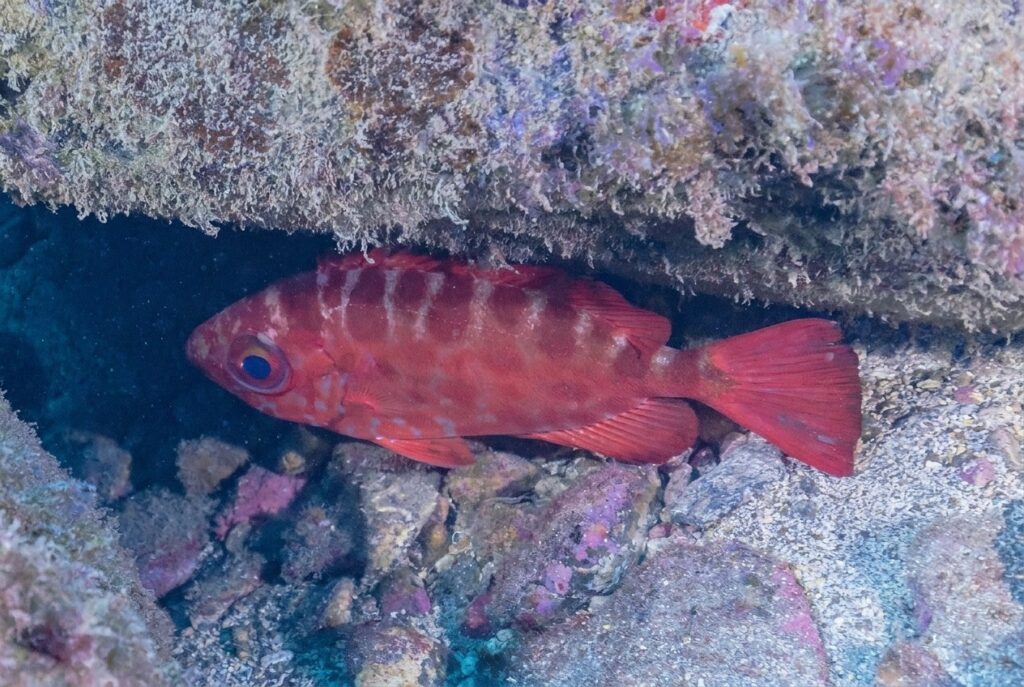
Atlantic species meet warmer-water ones here. Divers see octopus, cuttlefish, starfish, yellow gorgonians, sponges and shoals of sea bream, and the bright red parrotfish known locally as vieja.
Sea turtles are seen on some dives, most often at El Puertito de Armeñime, a sheltered bay about 6 metres deep near Costa Adeje. Never touch or feed them. Snorkellers find them there too, and our snorkelling guide explains how to watch them without disturbing them.
The sea off the west and south-west coast, from Teno to Rasca, is a protected marine area of almost 70,000 hectares in the European Natura 2000 network, the same stretch where pilot whales and dolphins live all year.
Try dives and courses
A try dive is the way to discover diving without a licence. It has to be run by an accredited centre or club, with a qualified instructor who stays with you at all times. You fill in a short medical form first: some conditions, such as asthma or a heart problem, need a doctor’s note.
- Try dive: a few hours, a few metres deep. PADI’s Discover Scuba Diving is open from the age of 10.
- Open Water Diver: the first licence, a few days of theory, pool or shallow water and open-water dives. It lets you dive to 18 metres with a buddy.
- Advanced and speciality courses: deeper dives, wrecks and night dives, for the north coast and its caves.
Centres teach to PADI or SSI standards, and some also to those of the Spanish federation (FEDAS), CMAS, ACUC or BSAC.
Rules for certified divers
- Diving with an authorised centre needs no extra paperwork: the centre arranges the local licence for you.
- Diving on your own, without a centre, needs your diving qualification, a diving licence and a medical certificate.
- In every case you need insurance that covers treatment in a hyperbaric chamber, rescue at sea and civil liability. A federation licence or a diving insurance policy does the job.
- Match each site to your qualification: wreck and deep sites require an advanced licence.
1 dive
Scuba Diving for Certified Divers in Costa Adeje
2 hours 30 minutes, from €55, free cancellation
Diving, flying and Teide
After diving, wait at least 18 hours before flying home, the usual medical advice after several dives. The same goes for the drive up to Teide and the cable car, which climbs to 3,555 metres: plan Mount Teide for the start of your stay and the dives for the days after it.
Where to stay for diving
Staying in the south puts you a few minutes from most dive centres. Los Cristianos and Costa Adeje have the widest choice of centres and hotels; see where to stay in Tenerife for each area.
Scuba diving questions
Do I need a licence to dive in Tenerife?
Not for a try dive with an accredited centre. To dive without an instructor you need a recognised licence, such as PADI or SSI Open Water, and insurance that covers a hyperbaric chamber.
How warm is the water?
Between 19 °C in late winter and 26 °C at the end of summer. A wetsuit is part of the kit all year.
Where are the best dive sites for beginners?
In the south and east: Montaña Amarilla, Los Chuchos, the El Condesito wreck and Abades, all shallow and with little current.
Can I see turtles when diving?
Sometimes, but sightings are never guaranteed. El Puertito de Armeñime, near Costa Adeje, is the best-known spot. Watch them from a distance, without touching or feeding them.
Can I go up Teide after diving?
Not on the same day. Wait at least 18 hours, as before a flight: the cable car takes you to 3,555 metres.
Read next
- Snorkelling with turtles in TenerifeTurtles and reefs with a mask and fins, no licence needed
- Whale and dolphin watching in TenerifePilot whales and dolphins off the same coast
- Kayaking in TenerifeThe cliffs and coves from the water’s surface