Tenerife weather by month, north and south
Updated 18 November 2026. Climate figures checked the same day.
Tenerife is warm all year on the coast, but it is not one climate. The south is dry and sunny, the north catches the trade-wind clouds and most of the rain, and the slopes of Teide can be close to freezing on a winter morning while people swim in Los Cristianos. This page gives the averages of the island’s four official weather stations, month by month, and what they mean for your days.
Quick answer
- On the south coast the average high goes from 21.7 °C in January to 28.4 °C in August, with about 15 days of rain a year.
- In the north it rains more: 520 mm a year at Tenerife North airport, against 132 mm at Tenerife South.
- On Teide, at 2,369 m, the average January low is 1.1 °C and there are about 12 days of frost. Pack a warm layer for the cable car.
- Wettest months: November to February. From May to September rain is rare everywhere on the coast.
On this page
- The south, month by month 21.7 to 28.4 °C
- North and south 132 mm against 520 mm of rain
- On Teide 1.1 °C average January low
- A day above the clouds from Puerto de la Cruz
- Rain, wind and haze
- Sunny bases
- FAQ
We may earn a commission when you book through our links. How it works
Month by month on the south coast
The main resorts are on the south coast, between Los Cristianos, Playa de las Américas and Costa Adeje. The nearest official station is at Tenerife South airport, 64 m above the sea. These are its averages over thirty years.
| Month | High | Low | Days of rain | Hours of sun |
|---|---|---|---|---|
| January | 21.7 °C | 15.2 °C | 1.8 | 193 |
| February | 22.0 °C | 15.0 °C | 2.2 | 195 |
| March | 23.1 °C | 15.6 °C | 1.9 | 226 |
| April | 23.1 °C | 16.0 °C | 1.1 | 219 |
| May | 23.9 °C | 17.0 °C | 0.3 | 246 |
| June | 25.4 °C | 18.8 °C | 0 | 259 |
| July | 27.7 °C | 20.2 °C | 0 | 295 |
| August | 28.4 °C | 21.1 °C | 0.2 | 277 |
| September | 27.9 °C | 21.1 °C | 0.6 | 213 |
| October | 26.8 °C | 20.0 °C | 1.6 | 214 |
| November | 24.8 °C | 18.2 °C | 1.9 | 193 |
| December | 22.8 °C | 16.5 °C | 3.5 | 195 |
A day of rain here means at least 1 mm. Even in December, the rainiest month, the south airport averages 30 mm, spread over three or four days. Between June and August the south has no rain to speak of and close to 300 hours of sun a month.
Days out that work in any season
Whale Watching Eco-Adventure from Costa Adeje
Pilot whales and dolphins live off this coast, and the sea trip runs in winter as in summer.
2 hours
Free cancellation
WhalesAt seafrom €65
Booked on Viator
Small Group Teide National Park Volcanic and Forest Wonders
Up to the national park with transport, often into clear sky above the cloud layer.
4 to 5 hours
Free cancellation
TeideMountainfrom €70
Booked on Viator
Teide National Park Sunset & Stargazing Coach Tour – Hotel Pickup
An evening on the mountain, when the day visitors have gone down to the coast.
8 hours
Free cancellation
SunsetEveningfrom €65
Booked on Viator
North, south and the capital
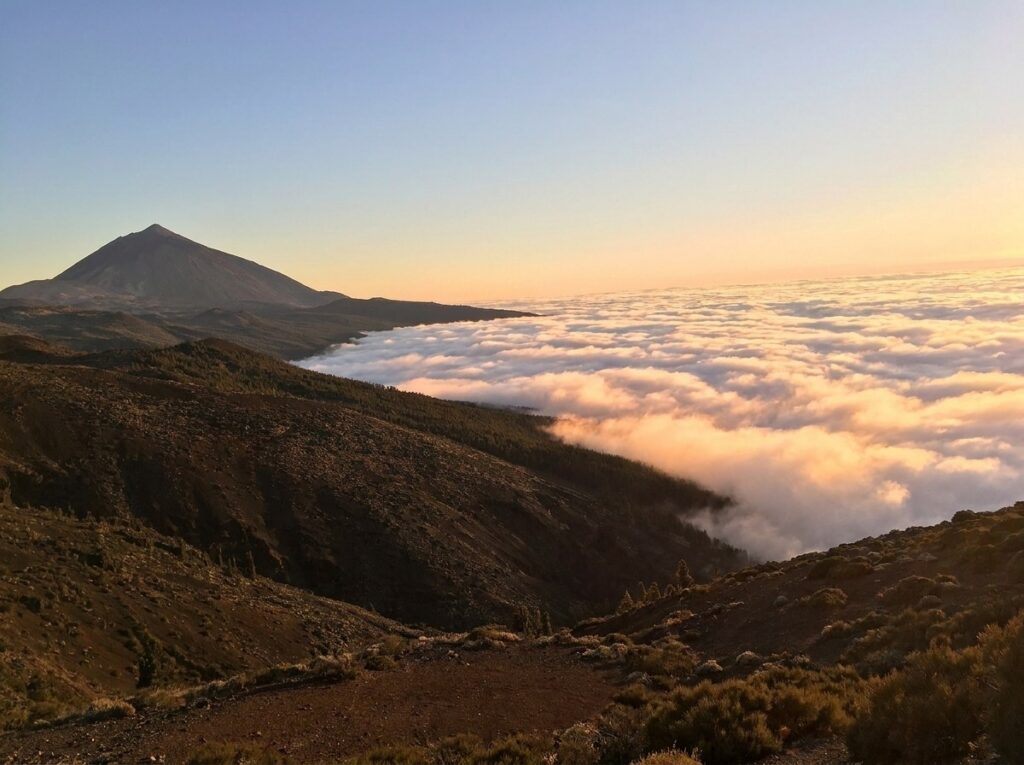
The north-east trade winds push clouds against the northern slopes, where they form a layer usually between 500 and 1,500 m. Below it, the north coast is mild and green; above it, the sky is often clear. The south lies in the lee of the mountains, which is why it gets so little rain.
| Station | January high | August high | Rain in a year | Clear days |
|---|---|---|---|---|
| Tenerife South airport, 64 m | 21.7 °C | 28.4 °C | 132 mm | 114 |
| Santa Cruz, 36 m | 21.0 °C | 29.0 °C | 226 mm | 92 |
| Tenerife North airport, La Laguna, 632 m | 16.0 °C | 25.7 °C | 520 mm | 44 |
| Izaña, Teide, 2,369 m | 7.5 °C | 22.6 °C | 392 mm | – |
Santa Cruz, on the east coast, is as warm as the south and sunnier than the south airport over the year: 2,913 hours against about 2,700, thanks to its sunnier summers. In winter the order turns: 168 hours in December in Santa Cruz, 195 at the south airport. La Laguna, about 600 m higher and 10 km away by road, is 5 °C cooler in January and has about 78 days of fog a year.
The north coast
Puerto de la Cruz has no official station of its own. Turismo de Tenerife gives it a range of 15 to 22 °C through the year: a little cooler than the south, and greener, with more cloud in the morning. In summer, that makes it a cooler base than the south.
The weather on Teide
The Izaña weather station stands at 2,369 m on the slopes of Mount Teide, about the height of the cable car base station. The summit is about 1,350 m higher, and colder still.
| Month | High | Low | Days of snow | Days of frost |
|---|---|---|---|---|
| January | 7.5 °C | 1.1 °C | 2.4 | 12.3 |
| March | 10.2 °C | 2.7 °C | 2.1 | 9.0 |
| May | 14.5 °C | 5.8 °C | 0.2 | 2.8 |
| July | 23.0 °C | 14.0 °C | 0 | 0 |
| September | 18.6 °C | 10.4 °C | 0 | 0 |
| November | 11.1 °C | 4.5 °C | 0.6 | 3.8 |
| December | 8.8 °C | 2.4 °C | 1.6 | 8.3 |
Izaña is also the sunniest of the four stations: it averages 382 hours of sun in June and July. In winter, snow and ice can close the roads into the national park, the TF-21 from La Orotava, the TF-24 from La Esperanza and the TF-38 from Chío, until the Cabildo has cleared them. Wind and ice can also stop the cable car: its operator shows the day’s status on its website.
Teide
Small Group Teide National Park Volcanic and Forest Wonders
4 to 5 hours, from €70, free cancellation
A cloudy morning in the north, a sunny day above it
When the north wakes up under grey sky, the sun is often just above it. This loop climbs through the cloud layer to the park and comes down on the sunny side of the island.
- Check the skyLook at the AEMET forecast for the park and the cable car status page before you set off.
- Leave Puerto de la CruzUp the TF-21 through La Orotava. The cloud layer usually sits between 500 and 1,500 m: you drive through it.
- El PortilloThe northern entrance of the park, above the cloud layer, with its visitor centre and botanical garden.
- The cable car45 km from Puerto de la Cruz. The upper station is at 3,555 m: bring the warm layer even in summer.
- Down to VilaflorThe TF-21 leaves the park on the south side through Vilaflor, the first village on the way down.
- Beach at Los Cristianos47 km from the cable car. Los Cristianos: the south coast averages a high of 21.7 °C in January, against 7.5 °C at Izaña.
Back to Puerto de la Cruz by the motorway in the evening. Check the cable car’s last ride up for the season: 16:00 in winter.
Rain, wind and dust haze
Bad weather on Tenerife comes in short spells, mostly between November and February. AEMET, the Spanish weather agency, publishes warnings for the island on its Meteoalerta page, including rain, wind, coastal swell and dust in the air, the haze from the Sahara known locally as calima.
- Rain: in the north, November, December and January each bring about 80 mm at the north airport.
- Wind and swell: some beaches have strong undercurrents. Follow the beach flags, and take extra care where there are no lifeguards.
- Heat and fire: wildfires happen on the islands in summer. Do not light barbecues, leave cigarette ends or leave bottles behind.
- Mountains: temperatures change fast with altitude. Check the forecast for the park, not for the coast.
Where the sun is most reliable
For the driest weather, stay in the south. For a greener, cooler holiday, the north coast. Our guide to where to stay in Tenerife compares the areas.
Tenerife weather questions
What is the warmest month in Tenerife?
August. On the south coast the average high is 28.4 °C and the low 21.1 °C; in Santa Cruz the high reaches 29.0 °C.
Does it rain much in Tenerife?
Not in the south: 132 mm a year at Tenerife South airport, over about 15 days. The north gets much more, 520 mm a year at Tenerife North airport, mostly between November and February.
Is it warm enough to swim in winter?
On the south coast the average high stays above 21 °C from December to February. The days are warm enough for the beach, between showers.
Does it snow on Teide?
Yes, a few days a year, mostly from December to March. Izaña, at 2,369 m, averages 2.4 days of snow in January. The roads into the park can close until they are cleared.
Is the north of Tenerife always cloudy?
No. The trade-wind clouds often form in the morning between 500 and 1,500 m, and the coast below and the mountains above can be sunny at the same time.
Read next
- The best time to visit Tenerife, month by monthThe weather, the prices and what is on, month by month
- Tenerife in winterNovember to February, the winter-sun season
- Mount TeidePlan the day up the mountain, with the right clothes